The registration form
for NSK News Bulletin E-Mailer
NSK News Bulletin Online
September 2005
-------------------------------------------------------------------
Newspaper, News Agency Work Force Declines for 13th Straight Year
An NSK annual survey has found that the number of full-time employees at member newspaper companies and news agencies was down 3.2 percent as of April 1, compared to the year before, falling to 52,683 in a 13th straight year-to-year decline. That is the largest drop since NSK began the survey in 1993.
The NSK Management and Business Division contacted all 102 NSK member newspaper companies and news agencies (down from 104 last year) on April 1.
A total of 71 companies responded to the general survey. The final figures incorporated the 31 non-respondent companies' employment data, which was collected separately. The figures cover all regular full-time employees, as well as those on contract or on loan, and those on leaves of absence. Board members, part-time workers and temporary staff were excluded.
--Total employment (See Table I)
Total NSK member employment peaked at 67,356 in 1992 and has been falling ever since.
The data from the 71 companies that took part in the broader survey came up to a total of 49,523 regular employees. The detailed breakdowns by division and divisional share were based on this figure.
Table I Total Number of Employees
|
2001 |
2002 |
2003 |
2004 |
2005 |
| Total (unit:person) |
57,860 |
57,105 |
55,806 |
54,436 |
52,683 |
| year-on-year figure (unit:%) |
- 2.1 |
- 1.3 |
- 2.3 |
- 2.5 |
- 3.2 |
(survey by NSK covered all newspaper and news agency member of NSK)
--Employment by job type, shares (See Table II)
By job type, the editorial division accounted for the highest share of all workers at 47.3 percent across the 71 companies, followed by the sales division, the production/printing/forwarding division, a section grouping “others,” the general affairs/administration division, and then the publishing, business, and electronic media divisions.
The employment share for the business division surpassed that of the production/printing/forwarding division for the first time this year.
Over the past 10 years, editorial division employment has risen 6 percentage points, and publishing, business, electronic media, and the “others” division employment has grown 2.5 percentage points (in the 1996 survey, business and electronic media was also grouped in “others”). Over the same 10 years, employment in production/printing/forwarding has fallen 10.9 percentage points.
--Gender
The data from the 71 companies shows the share of female employees rose 0.4 percentage points in the past year. As of April 1, there were 20,315 reporters, of which 2,436 were female, with their share rising 0.3 percentage points to 12.0 percent.
Table II Sectionally Total Number of Employees
|
Total |
Men |
Women |
| Editorial |
23,439 |
(47.3) |
20,525 |
(41.4) |
2,914 |
(5.9) |
| Printing |
6,881 |
(13.9 ) |
6,708 |
(13.5 ) |
173 |
(0.3 ) |
| Business |
7,386 |
(14.9) |
6,542 |
(13.2) |
844 |
(1.7 ) |
| Publishing |
3,312 |
(6.7 ) |
2,727 |
(5.5 ) |
585 |
(1.2 ) |
| Administration |
4,003 |
(8.1 ) |
3,095 |
(6.2 ) |
908 |
(1.8 ) |
| Others |
4,502 |
(9.1 ) |
4,295 |
(8.7 ) |
207 |
(0.4 ) |
| Total |
49,523 |
(100.0 ) |
43,892 |
(88.6 ) |
5,631 |
(11.4 ) |
( )=composition ratio
--Age (See Table III)
Based on the data from 70 companies, (one company did not supply employment data broken down by age), workers aged from 55 to 59 represented the largest group, followed by those aged 35-39, and then those 40-44.
Tracking age-group proportions over the past 10 years, the percentage in their 30s has grown the most, rising 5.3 percentage points, followed by those in their 50s, up 2.2 percentage points. The percentage of staff under 20 fell 6.3 percentage points, followed by those in their 40s, which declined by 1.8 percentage points.
Table III Employees Breakdown by Age
〈Unit:%〉
|
2001
|
2002 |
2003 |
2004 |
2005 |
| number of company to a survey |
77 |
76 |
81 |
79 |
70 |
| 〜19 |
0.1 |
0.1 |
0.0 |
0.1 |
0.1 |
| 20〜24 |
4.2 |
4.0 |
3.9 |
3.4 |
3.2 |
| 25〜29 |
12.4 |
11.8 |
11.5 |
11.1 |
10.5 |
| 30〜34 |
14.3 |
14.3 |
14.1 |
13.9 |
13.8 |
| 35〜39 |
13.8 |
13.7 |
14.9 |
15.4 |
15.3 |
| 40〜44 |
11.1 |
12.4 |
12.5 |
13.0 |
14.3 |
| 45〜49 |
11.1 |
10.7 |
10.7 |
11.3 |
11.7 |
| 50〜54 |
17.4 |
16.4 |
15.2 |
13.5 |
12.4 |
| 55〜59 |
13.9 |
14.9 |
15.6 |
16.3 |
16.7 |
| 60〜 |
1.6 |
1.7 |
1.7 |
2.0 |
1.9 |
--Staff additions, losses (See Table IV)
In the year to April 2, 2004, there were a total of 1,219 male new hires and 350 female new hires. The male employees made up 77.7 percent of the new hires and females 22.3 percent. The new staff represented 3.2 percent of the total, up 1.0 percent from the year before.
During the year, 2,169 males (89.7 percent) and 248 females (10.3 percent) left the respondent companies, representing a loss of 4.9 percent of the work force, the same ratio as in the previous year.
Table IV Number of New Employee and Displaced Worker
|
2001 |
2002 |
2003 |
2004 |
2005 |
| number of company to a survey |
77 |
76 |
81 |
79 |
71 |
| Total |
54,505 |
54,015 |
53,488 |
51,761 |
49,523 |
| (5,529) |
(5,606) |
(5,785) |
(5,695) |
(5,631) |
| New Employee |
1,267 |
1,332 |
1,177 |
1,134 |
1,569 |
| (290) |
(330) |
(292) |
(296) |
(350) |
| Displaced Worker |
2,678 |
2,735 |
2,364 |
2,542 |
2,417 |
| (310) |
(284) |
(282) |
(265) |
(248) |
( )=number of women
Asahi Fires Reporter, Punishes Top Editors Over Faked Election Scoop
The Asahi Shimbun on Aug. 29 fired a reporter and removed its managing editor over a scandalous fake election scoop that alleged that key politicians opposed to the governing Liberal Democratic Party were secretly collaborating across party lines.
A reporter at the newspaper’s Nagano bureau fabricated information and prepared fictitious notes used in articles about how Nagano Governor Yasuo Tanaka became the leader of a new opposition party. The articles appeared in the Aug. 21 and 22 issues of the daily newspaper.
In announcing the reporter's firing and the removal of the responsible managing editor in Tokyo, the newspaper said the incident had seriously undermined its credibility.
In its Aug. 30 morning issue, the Asahi Shimbun published an apology and the results of an in-house investigation. It also established an in-house committee aimed at regaining readers’ trust.
The falsified reports alleged that the Nagano governor assumed the leadership of the new political party Shinto Nippon through a secret meeting with Shizuka Kamei, a former policy chief of the Liberal Democratic Party. Subsequent checks found that the reporter invented the venue of the meeting and Gov. Tanaka’s remarks during the meeting, writing fictitious notes to support his claims.
The newspaper said the reporter had been assigned by the bureau chief to provide information on a meeting to the political news office in Tokyo. The reporter submitted notes to the bureau chief on Aug. 20, without ever contacting the governor. He fabricated the notes based loosely on previously reported remarks by the governor.
Gov. Tanaka subsequently listed the factual errors in the articles at a news conference, prompting the Asahi Shimbun to launch its probe.
A spokesman for the Asahi Shimbun on Aug. 29 issued a statement saying that the incident had seriously undermined public trust in the newspaper. “This act violated journalistic ethics and should never have happened. We accept heavy responsibility and deeply apologize to those improperly referred to in the article as well as to our readers,” the spokesman said.
The Asahi Shimbun also announced that it is setting up “a committee for credible reporting, that will assess reporters' conduct in the field and issues related to the way they gather information."
Topics.......Topics.......Topics........
|
8 Young Journalists Take Hiroshima Training Course on the A-bombing
Eight young reporters, each representing a regional or local newspaper, took the journalist training course that is run every year by Hiroshima City from late July through early August.
The “Course on Hiroshima” helps journalists gain deeper knowledge about the A-bombing of the city 60 years ago and encourages them to report their findings to their readers.
The course, which is now in its fourth year, ran from July 29 through Aug. 7. Participating journalists wrote by-line articles, serialized features and analyses on Hiroshima in time for the 60th anniversary of the end of World War II.
This year, seven of the participating journalists were in their 20s and one in his 30s. They attended briefings on the sociological and health damage caused by the atomic bombing, heard testimonies of A-bomb survivors, and reported on various memorial events.
One reporter, from the Kumamoto-Nichinichi Shimbun, wrote a serialized feature in six installments, titled “Walking through Hiroshima, Summer 2005,” that was published starting on Aug. 9.
The reporter interviewed a representative of ethnic Korean atomic-bomb survivors who are still speaking out today against the wartime Japanese Imperial Army and the Japanese government. “I was shocked to hear these voices of foreign A-bomb survivors, and I reaffirmed the importance of historical events in this issue,” the reporter said.
Visiting the Hiroshima Peace Memorial Museum, the reporter met an American who justified the bombing. “I had mixed feelings about his remarks," the reporter recalled, adding that as the world’s sole victim of atomic weapons, the Japanese people need to keep telling future generations about the true horror of the atomic bomb.
Another reporter, from the Ehime Shimbun, wrote a bylined article titled, “Hiroshima Youth Carry On A-bomb Legacy,” published on the paper's Aug. 14 issue. The article features university students and other youth promoting a campaign for people to imagine and then draw pictures of the scenes described to them by atom-bomb survivors.
“The A-bomb survivors are now very old and their days are numbered. In my article, I emphasized the need for future generations to inherit the experiences of the survivors,” the reporter said.
The Ehime Shimbun devoted extensive coverage to the atomic bombing of Hiroshima, using articles from the young reporter and others working in collaboration with a local cable television station.
|
<< back
Story of the Month>>>
NIE Convention: Newspapers, the Best Materials for Communication Skills
|
|
Teachers continue to praise the “Newspaper in Education (NIE)” programs in schools as a great help to students developing their communication skills. Teachers discussed the growth of NIE at the NIE National Convention in Kagoshima City in late July.
The 10th annual NIE National Convention was part of the overall NIE program sponsored by the Newspaper Foundation for Education and Culture. (See our earlier report in the August online issue of the NSK News Bulletin).
On July 29, the second day of the convention, schoolteachers gave demonstration classes of their NIE activities and then held discussions in sub-groups for elementary, junior high and senior high school education.
At the junior high school group, Koichi Ninomiya, a teacher at Yoshino Junior High School in Kagoshima City, demonstrated how he used newspapers in his NIE class on the subject of Kagoshima Berkshire "Kurobuta", a local specialty product.
Ninomiya said he asked his students to chose one of three suggested topics for an investigation - 1) the history of black pigs in Kagoshima, 2) the method of farming the pigs; and 3) the issue of deceptive origin labeling. All of the students' studies were then based on a series of articles on the pigs carried in the local Minami-Nippon Shimbun.
For a class presentation, the students were to summarize their findings. The local newspaper reporter who wrote the serial articles attended as a guest and also answered students’ questions.
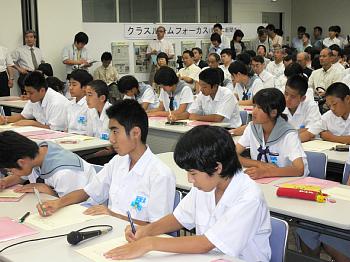
At the senior high school group, Hiroaki Ikenouchi, a teacher at the Kanoya Agricultural High School reported on an NIE class in which he focused on the history of Hansen’s Disease as a human rights issue for the class subject of Modern Society.
After introducing the basic issue of human rights from a textbook, the teacher showed the students newspaper clippings on Hansen’s disease. Ikenouchi said newspaper articles excel in giving a detailed explanations and in recording events as they happened.
After a classroom discussion and upon preparing essays, several students were selected to visit a sanatorium for Hansen's Disease patients. At the end of the course, a reporter who has written about the issue in the local Minami-Nippon Shimbun came to the class to deliver a lecture.
A survey on NIE classes found that 70 percent of participating students greatly appreciated the course method and results. Many said that newspaper articles carry more detailed information than school textbooks and that newspapers publish comments from the various parties in a balanced manner that lets them see the complexity of an issue. On the other hand, some students did complain that newspapers use too many complex Kanji-style characters, making it tough to read through an article.
One participant asked from the floor whether any of the students taking the NIE class on Hansen's disease found a parallel between the ostracism of those patients and the bullying among students that is a major problem in Japanese schools. Ikenouchi said there had been no overt mention of such a parallel, but he said, “The students should have seen the evil in discrimination in general."
"They need to deepen their studies, and we need to keep promoting these kinds of educational activity that do just that,” he said.
|
|
|
Nihon Shinbun Kyokai
The Japan Newspaper Publishers & Editors Association
Nippon Press Center Bldg., 2-2-1 Uchisaiwai-cho, Chiyoda-ku,
Tokyo100-8543, Japan
bulletin@pressnet.or.jp
Copyright 2005 Nihon Shinbun Kyokai
All right reserved
|
|
|
|
|