The registration form
for NSK News Bulletin E-Mailer

NSK News Bulletin Online
January 201
0
-------------------------------------------------------------------
* Mainichi to join Kyodo News network in April
* JANPS 2009 Shows Innovative Newspaper Production Technologies
- - - - - - - - - - - - - - - - - - - - - - - - - - - - - - - - - - - - - -
*Topics
Cenotaph Re-built to Mark Founding of Japan¡Çs First Daily Newspaper
- - - - - - - - - - - - - - - - - - - - - - - - - - - - - - - - - - - - - -
Story of the Month>>>
Japanese Newspaper Firms Seeking New Business Prospects
-------------------------------------------------------------------

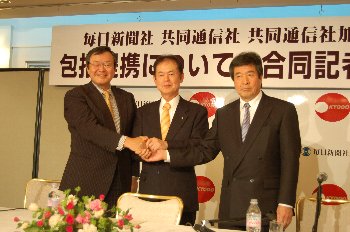
Mainichi to join Kyodo News network in April

Mainichi Newspapers Co. will join the Kyodo News network as a member newspaper on April 1 and will collaborate with Kyodo¡Çs other member newspapers on an individual basis, the newspaper announced. The Mainichi said that the tie-ups will enable Mainichi reporters to concentrate on newsgathering activities in order to provide more original and in-depth news analyses and commentaries.

According to the Mainichi, the tie-ups will enable the newspaper, Kyodo News, and Kyodo member newspapers to jointly organize press campaigns and symposia, to publish debates by editorial writers from the three parties, to jointly hold discussions among their third-party ombudsperson bodies, and to jointly sponsor sports and cultural events as well as a wide range of exhibitions.

Mainichi President Yutaka Asahina told a news conference that in the coming era, newspapers will have to provide more analytical articles and commentaries, in addition to factually correct news reports.

¡ÈThe Mainichi will strive to depart from what I call ¡Æannouncement journalism.¡Ç While Mainichi reporters will base their newsgathering activities on press clubs, they will also be encouraged to concentrate on their own original newsgathering, as we will be able to fully utilize Kyodo wire stories about government and business announcements,¡É he said.

Mainichi officials said that negotiations are under way with more than 10 Kyodo-member regional newspapers to use their local articles for its regional editions in areas where the Mainichi has no local office of its own reporters.

However, the Mainichi will maintain its present network of local branches and regional pages, and the tie-up will not result in any personnel reductions, the officials said.

Asahina said that there are other areas where the company could cut back on expenditures, adding that the enrichment of the newspaper¡Çs editorial content would lead to an increase in circulation and ad revenues.

The Mainichi also envisages cooperation with Kyodo and its member newspapers in the upgrading of its editorial composition system, the outsourcing of printing and the efficient operation of newspaper sales networks. The Mainichi and Kyodo will also study collaboration in aerial coverage of news events, the officials said.


Asahina (left) and Ishikawa (right) announce Mainichi's join to Kyodo News

<< back


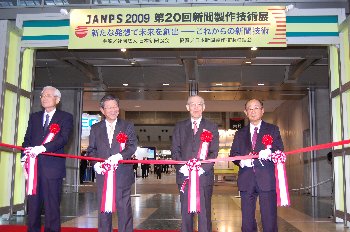
JANPS 2009 Shows Innovative Newspaper Production Technologies

The 20th bi-annual Japan Newspaper Production Show -- JANPS 2009 ?- attracted 15,533 visitors over the course of a four-day show that opened on Nov. 24 at the Tokyo Big Sight congress hall and event space. NSK organized the event with the support of the Conference for Newspaper Production Technique (CONPT-Japan).

The show¡Çs theme of ¡ÈCreating the Future with New Ideas -- Newspaper Technology of the Future,¡É motivated 48 companies and organizations to exhibit their latest equipment and systems for newspaper production, showing a road forward in defiance of the worsening economic environment.

The Sankei Shimbun became the first newspaper company to participate in the fair as an exhibitor demonstrating a system for printing on variable paper sizes. Sankei has developed technology to print a newspaper of broadsheet format with both its width and height being reduced to 9 cm less than the standard. The newspaper company distributed copies of a special edition released in its reduced-size format at the fair.

Other technologies featured at the show included a first demonstration printing of so-called 4x1 press models and a display of content-management systems and electronic newspaper production systems.

Tokyo Kikai Seisakusho, Ltd., a major printing-press maker, conducted a demonstration of its latest digital printing equipment. The maker also reported on the adoption of its presses by Joong Ang Ilbo, a major daily newspaper in South Korea, which launched publication of a daily paper in what is known as Berliner format, starting in March of last year.

Numerous eco-friendly technologies were also on display at the fair. Mitsubishi Paper Mills Limited introduced technology to develop plates for CTP (computer-to-plate) systems using neutral aqueous liquor. Fujifilm Graphic Systems exhibited equipment intended to reduce by one-eighth the volume of waste liquid generated in the process of developing its plates.

Ink makers introduced eco-friendly products, while font developers demonstrated new fonts adhering to the ¡Èuniversal design¡É concept.


Ribbon-cutting at opening ceremony of JANPS2009

<< back


Topics.......Topics.......Topics........

Cenotaph Re-built to Mark Founding of Japan¡Çs First Daily Newspaper


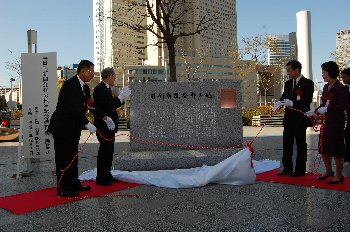
The Kanagawa Shimbun re-erected a cenotaph at the site of its establishment as Japan¡Çs first daily newspaper in Naka Ward, Yokohama, opening it to the public in an unveiling ceremony on Dec. 7.

Some 100 representatives of the Yokohama Municipal Government and the media industry, including NSK Chairman Hitoshi Uchiyama, attended the ceremony.

The reconstruction of the cenotaph is part of a series of events to mark the Kanagawa Shimbun newspaper company¡Çs 120th anniversary of its founding in February of this year.

At the cenotaph ceremony, Kanagawa Shimbun President Kenji Hotta praised the contributions made by the nation¡Çs first daily newspaper, the Yokohama Mainichi Shimbun, lauding its dissemination of the news and its development of Japanese culture.

¡ÈI hope that this cenotaph, along with NEWSPARK - the Japan Newspaper Museum in Yokohama, will be long remembered as a historical monument marking the commencement of Japan¡Çs modernization in the wake of the Meiji Restoration, Hotta said in an address. He also said that the cenotaph was built to pass the tradition and pride of newspaper people down through generations by focusing on the mission of newspapers.

The Kanagawa Shimbun, in cooperation with NSK and other parties, first built the cenotaph at a different place in 1962. But, the monument was removed from its original location due to an urban redevelopment project.

In re-erecting the cenotaph, the epigraph was partially revised, but its chirography was reproduced in the same mode as that of the original. The cenotaph is made of granite stone. A copper plate representing the first issue of the Yokohama Mainichi Shimbun is embedded in the new cenotaph.

Kanagawa Shimbun President, NSK Chairman, Kanagawa Governor and
Yokohama Mayor attended the cenotaph ceremony

¡¡
Story of the Month>>>

Japanese Newspaper Firms Seeking New Business Prospects

In 2009, the Japanese newspaper industry suffered a large drop in ad revenues and a decline by more than 1 million copies in combined circulation.

In a worsening environment in which many newspaper companies are finding it increasingly difficult to sustain their business solely through newspaper publication, their biggest challenge in the new year will be determining how to develop or ensure new revenue sources, including raising earnings in so-called digital business activity.

Newspaper firms are set to increase their efforts to cut spending by entering into production tie-ups with other firms. A number of newspaper companies have already launched early retirement programs, sending a signal that staff reductions are likely to spread across the newspaper industry.

Advertising

Newspaper companies are counting on the Vancouver Winter Olympics, soccer¡Çs World Cup 2010 in South Africa, and Japan¡Çs upcoming Upper House election as chances to boost ad revenues. However, the Democratic Party of Japan (DPJ), in its election pledge for the 2009 general election, promised to lift the current ban on using the Internet for election campaigns. The newspaper industry is closely watching DPJ government activity in this field, which might greatly affect election-related advertising in print newspapers.

Newspaper firms are aiming to attract new advertisers through a cross-media approach, while prodding editorial, circulation and event-business departments to team up with advertising department staff for sales promotions. Many regional newspapers are concentrating on sales promotions with local businesses as their target.

Circulation

In order for newspaper companies to maintain their door-to-door newspaper delivery systems and to resolve their financial problems, they need to develop fair sales competition. Taking the successful restoration of fair sales conditions in the Kansai region as a model, the newspaper industry now aims to promote such efforts in other regions of the country. Another upcoming challenge will be how to attract new subscribers at a time when an increasing number of young people are not reading newspapers at all.

Production

This year, even more newspaper companies aim to outsource the printing of their newspapers to other newspaper firms in order to reduce expenditures on the outsourcing side and to make more effective use of their own facilities. The Asahi Shimbun will in April assign the Minami-Nippon Shimbun, a regional newspaper based in Kagoshima Prefecture, to print its editions for distribution in Kagoshima Prefecture and in the southern part of Miyazaki Prefecture. The Yomiuri Shimbun is to consign the printing of its editions in the Joetsu and Chuetsu areas in Niigata Prefecture to the Niigata Nippo, a regional newspaper based in Niigata Prefecture, starting in the fall of 2010.

Kyodo News and the Sankei Shimbun are planning to introduce content management systems (CMS) this year with the aim of effectively delivering news contents via a multimedia platform.

Electronic Media

While ad revenues continue to fall, many newspaper publishers are expected to make serious efforts to launch news sites on the Internet, and to attract paid subscription as a new source of revenues.

This spring, the Nihon Keizai Shimbun (Nikkei) is to launch a full-fledged electronic newspaper project. The Nikkei¡Çs plan is expected to trigger moves in the Japanese newspaper industry toward a shift from free news Web sites to paid-subscription sites. In December 2009, the Wall Street Journal from the United States launched a paid-subscription news Web site in Japanese. The monthly subscription fee is 1,980 yen.

Portable e-book readers are expected to debut in Japan this year with the capacity to download a multitude of publications ranging from books to newspapers, while also offering simple, direct Internet access. The U.S.-based Internet retail giant Amazon plans to market its own e-book reader, the Kindle, in Japan. Amazon has a policy of setting the prices for e-book and e-newspaper content on its own. As a result, newspaper publishers and other content providers are pledging to remain prudent when considering whether to make their contents available for the Kindle.

In addition, Apple Inc. is introducing new high-performance iPhone models and other makers are marketing smart phones capable of browsing page images of newspapers. Newspaper companies are exploring possibilities for ensuring revenues by supplying contents to such mobile terminals. There is also a possibility that the growing dissemination of smart phones will provide newspaper firms a chance to generate new revenues, beyond their current paid subscription model, via the development of new forms of advertising corresponding to the sophisticated functions of such mobile devices.

Some software development firms have already started providing a common platform for the distribution of page images from newspapers over the Internet. The companies say newspaper publishers could enter the digital content distribution business without any front-end payments or maintenance fees, merely by signing people up to try using their services. If many newspaper publishers were to implement such services, end-users would be able to search articles from multiple newspapers in a cross-sectional manner while additionally benefiting from the improved usability of such Web sites.

Nihon Shinbun Kyokai
The Japan Newspaper Publishers & Editors Association
Nippon Press Center Bldg., 2-2-1 Uchisaiwai-cho, Chiyoda-ku,
Tokyo100-8543, Japan

bulletin@pressnet.or.jp

Copyright 2008 Nihon Shinbun Kyokai
All right reserved